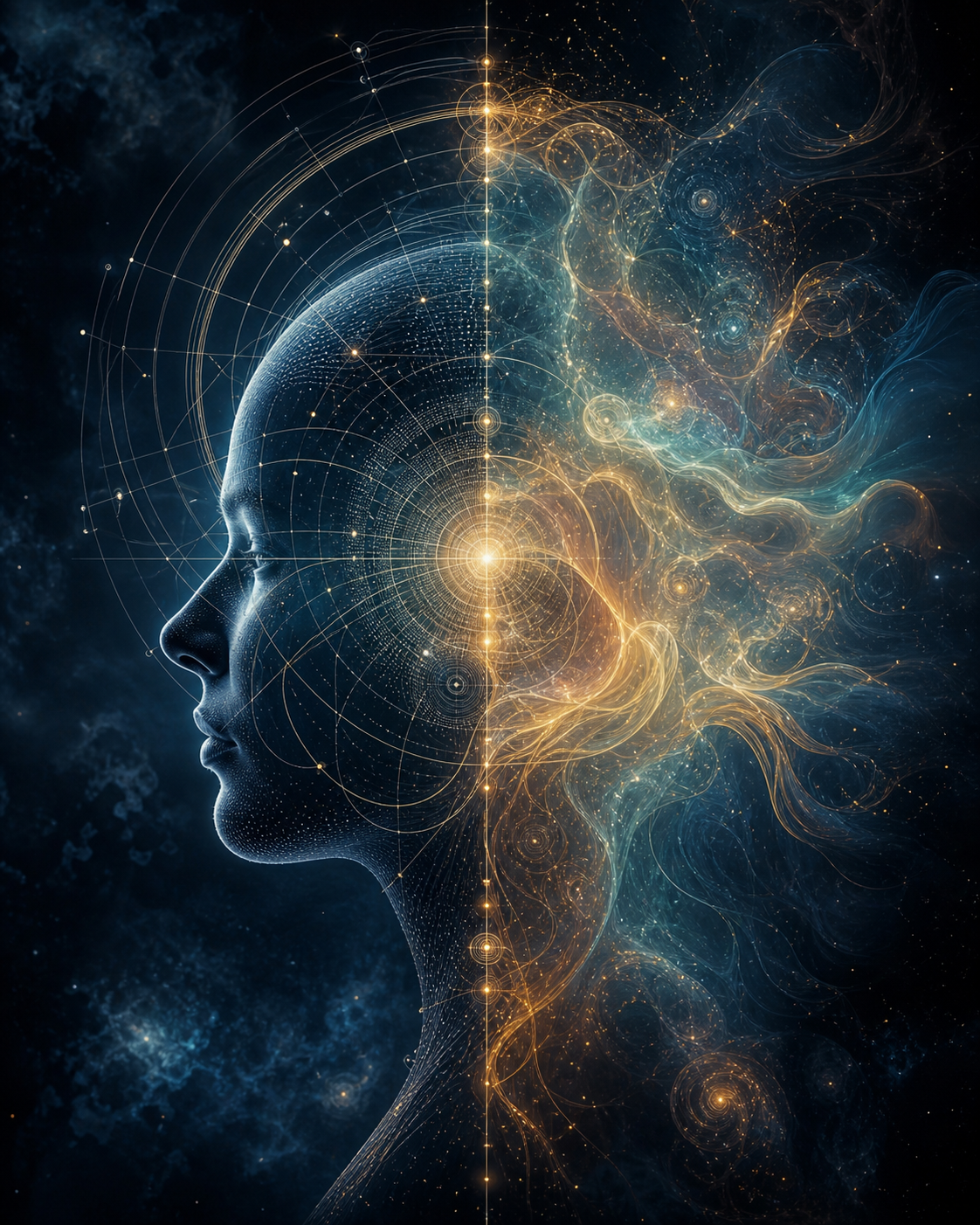
Search quantum consciousness and you will find two completely different conversations stacked on top of each other, broadcasting on the same frequency. One is a serious open question in physics and philosophy of mind, asked by people with full careers and no incentive to embarrass themselves. The other is a wellness genre that uses the word “quantum” the way a magician uses the word “abracadabra.” They share vocabulary. They share almost nothing else.

The trouble is that the static is louder than the signal, and most people only ever hear the static. Then they either believe it uncritically or dismiss the entire field because of it. Both responses miss what is actually interesting. The legitimate question — whether consciousness involves processes that classical neuroscience cannot fully explain — is unresolved. The pop version exists because the legitimate question exists. You cannot tune in the signal without first learning what the static sounds like.
Why Quantum Consciousness Became a Pseudoscience Magnet
Quantum mechanics has two features that make it irresistible to anyone selling certainty about the unknown. It is genuinely strange — particles behave in ways that violate intuition, observation appears to influence outcomes, distant systems remain correlated in ways nobody fully understands. And it is genuinely difficult — the math is brutal, the interpretations are contested, and almost nobody outside physics can tell when someone is bluffing.
Combine those two features and you get a perfect cover story. If you want to claim that thoughts shape reality, that the universe is conscious, that you can manifest a parking spot through aligned vibrations, the word “quantum” lets you skip the burden of proof. The strangeness of real quantum mechanics is offered as evidence that any sufficiently strange claim is plausible. It is not. Quantum mechanics is strange in specific ways, under specific conditions, at specific scales. “Strange” is not a transitive property.
This is the static. It uses the language of physics to bypass the discipline of physics. The serious thinkers in this field have spent decades trying to be heard over it, with mixed results.
What Roger Penrose Actually Argued
Penrose is a mathematical physicist who shared the 2020 Nobel Prize for his work on black holes. In The Emperor’s New Mind and Shadows of the Mind, he argued something specific and falsifiable: that human mathematical insight involves processes that cannot be reproduced by any classical computer, no matter how powerful. His route there runs through Gödel’s incompleteness theorems and a careful analysis of what algorithms can and cannot do. The conclusion is that consciousness must involve something non-computable, and the only physics we know that fits the bill is quantum.
With anesthesiologist Stuart Hameroff, Penrose proposed a specific mechanism — orchestrated objective reduction, or Orch-OR — situating quantum effects in microtubules inside neurons. The proposal is contested. Many physicists argue the brain is too warm and wet for quantum coherence to last long enough to matter. Penrose has responses. The debate continues. The point is that this is a real scientific argument with predictions and critics, not a slogan. The Stanford Encyclopedia of Philosophy maintains a careful overview of the field at its entry on quantum approaches to consciousness, which is the best single starting point for anyone who wants to read the actual literature.
What Penrose did not say: that you create reality with your thoughts. That intentions have measurable quantum effects on outside events. That consciousness is a vibrational frequency you can raise. He has been vocal about being misquoted by the wellness industry. The misquotes continue.
What David Bohm Actually Argued
Bohm was a theoretical physicist of the first rank — collaborator with Einstein, author of a foundational textbook, originator of an alternative interpretation of quantum mechanics that remains a serious option today. Late in his career he developed what he called the implicate order: the idea that beneath the explicate world of separate objects there is an underlying wholeness in which everything is enfolded into everything else. He thought consciousness and matter were two aspects of this deeper order rather than separate substances.
This is metaphysics, and Bohm knew it was metaphysics. He was careful to distinguish his philosophical speculations from his physics. What he was after was a framework that could hold both quantum nonlocality and the felt fact of subjective experience without forcing one into the language of the other. Whether he succeeded is a live question. That he was doing serious work is not.
The wellness industry has flattened Bohm into a soundbite — “everything is connected, therefore your vision board works.” This is not what he said. He said that the assumption of separateness might be a feature of how we perceive rather than how things are. That is a much stranger and more interesting claim, and it does not come with action items.
Where the Real Uncertainty Lives
Strip away the static and strip away the overreach, and what remains is this: nobody has explained consciousness. The hard problem — why there is something it is like to be you, why subjective experience exists at all — has resisted every approach we have thrown at it. Classical neuroscience can describe the correlates of consciousness in extraordinary detail. It has not explained why those correlates feel like anything from the inside.
The quantum consciousness hypothesis is one attempt to address this gap. It may turn out to be wrong. Many researchers think it already has. But the alternative explanations are not in better shape, and the question itself is not going away. Honest scientists working on this stuff hold their views loosely. They are trying to figure out something difficult. They are not selling courses.
The mature position, if you want one, is this: take the question seriously, take the existing answers provisionally, and treat anyone who claims certainty in either direction as evidence about the speaker rather than the topic.
What Quantum Consciousness Means for Human Potential
The honest answer is less marketable than the dishonest one. Quantum consciousness, even in its most generous interpretation, does not give you superpowers. It does not let you bend probability with your thoughts. It does not turn intention into a force. What it might do, if Penrose and others turn out to be onto something, is widen the picture of what minds are by a factor we cannot yet measure.
That widening is not nothing. The assumption that you are a meat computer producing the illusion of experience is not neutral — it shapes how you treat your own attention, your own intuitions, the moments when something in you knows something your reasoning cannot account for. If consciousness is doing more than classical models suggest, taking your inner life seriously becomes less of a sentimental indulgence and more of a reasonable bet on incomplete data.
That is the practical takeaway. Not a technique. A reframe. The science is unfinished. Live accordingly.
Frequently Asked Questions
Is quantum consciousness a real scientific theory?
Parts of it are. The Penrose-Hameroff Orch-OR model is a published, falsifiable hypothesis with predictions and critics. Bohm’s implicate order is philosophy of physics rather than empirical science, but it is rigorous philosophy by a serious physicist. The pop versions circulating online are neither science nor serious philosophy.
Did Roger Penrose prove consciousness is quantum?
No. He argued that consciousness must involve non-computable processes and that quantum mechanics is the most plausible candidate. That is an argument, not a proof, and it remains contested. Penrose himself treats it as an open question, not a settled one.
What did David Bohm say about consciousness?
Bohm proposed that consciousness and matter are two aspects of a deeper underlying order rather than separate things. He framed this as philosophical speculation grounded in his work on quantum nonlocality, not as empirical science. He was explicit about the distinction.
Can quantum consciousness explain the law of attraction or manifestation?
No. There is no credible scientific basis for using quantum mechanics to support the claim that thoughts directly shape external events. Researchers in the field, including Penrose, have repeatedly distanced themselves from this kind of misuse.
Why does quantum consciousness attract so much pseudoscience?
Because quantum mechanics is genuinely counterintuitive and genuinely hard, which makes its vocabulary easy to borrow and difficult to verify. Anyone selling certainty about the unknown finds the word “quantum” useful. The borrowing is rarely accompanied by the math.