Awareness
Transformation is an integral part of life — not something imposed upon it, but an extension of it. It is holistic by nature, touching every aspect of what a person is: the way they think, the way they feel, the way they move through the world. But these are the surface. Beneath them lies something deeper — spiritual energy, the living source from which all thought, feeling, and action arise.
To pursue a goal with clarity, express our inner world with truth, and move through life with purpose, we gather, transform, and direct this energy with intention. Not randomly, not reactively, but with the kind of deliberate attention that only becomes possible when one can first see clearly what is actually present.
At the center of every genuine transformation stands awareness — the capacity to see what is, before reaching for what could be. Nothing can be chosen well, pursued honestly, or changed with lasting effect without it. It is not the first principle because it was placed first. It is first because nothing else can begin without it.
Learn more about the awareness principle.
Reason
Not every path leads where it appears to lead. The mind is capable of convincing itself of many things — that more is better, that effort alone is enough, that what has worked for others will work here. Possibility is not the same as wisdom. The fact that something can be done has never been sufficient reason to do it.
Reason is the faculty that examines what awareness reveals. It does not act before the path is confirmed. It asks whether what has been seen is genuinely worth pursuing — and it asks this before anything is set in motion. A goal chosen without reason may be pursued with great sincerity and great effort, and still lead nowhere worth going.
It is not cold calculation. It is the quiet work of discernment — combining what is known, what is felt, and what is true about one’s own particular situation, and finding the path that is not merely possible but genuinely right. Even the deepest inner conviction, however sincerely felt, is not enough. Awareness is the open eye. Reason is the direction of the gaze.
Learn more about the reason principle.
Pareto Principle
There is a quiet recognition that comes when the noise settles — that not everything done in a day carries equal weight. That some efforts, small and unassuming, move everything forward. And that others, however earnest, however consuming, leave things exactly where they were.
This is not a failure of commitment. It is a failure of direction. Energy is not the problem. Where it goes is.
The Pareto Principle names this truth precisely: twenty percent of effort produces eighty percent of results. But it is not a tool that can be lifted out of context and applied anywhere.
Without Awareness, the wrong things are seen. Without Reason, the wrong path is confirmed. And without both, the twenty percent that gets repeated is simply the wrong twenty percent — faithfully, consistently, and to little effect.
Once the path has been seen clearly and confirmed as genuinely worth walking, what the Pareto Principle offers is concentration. Not more effort, but effort directed at what carries the most. The work does not multiply. It lands.
Kaizen
Transformation does not arrive in a single moment. It comes quietly, in the small choices made consistently, in the commitment to be slightly better today than yesterday — and not merely better in skill or output, but better in character, in intention, in the quiet substance of who one is.
Kaizen is the Japanese word for this truth. It is formed from two characters — kai, the discipline to change oneself, and zen, virtue and goodness. The common translation, continuous improvement, loses what matters most. Improvement without moral direction is not Kaizen. One can grow more capable, more efficient, more effective — and move further from goodness with every step. The direction is inseparable from the practice.
And because the direction matters, the step that is worth repeating faithfully is not always the obvious one. It is the one that has been seen clearly, chosen carefully, and confirmed as genuinely good. This is where Awareness, Reason, and the Pareto Principle do their silent work — finding the step that is worth taking, so that Kaizen can do what it does best: repeat it faithfully, patiently, and well.
What it asks for, once the ground is prepared, is patience. Not the passive waiting of someone who has given up, but the active trust of someone who knows that the foundation being laid today, though invisible, is what everything else will stand upon. Character is not built in the extraordinary moment. It is built in the ordinary one — steady, humble, and faithful to the path.
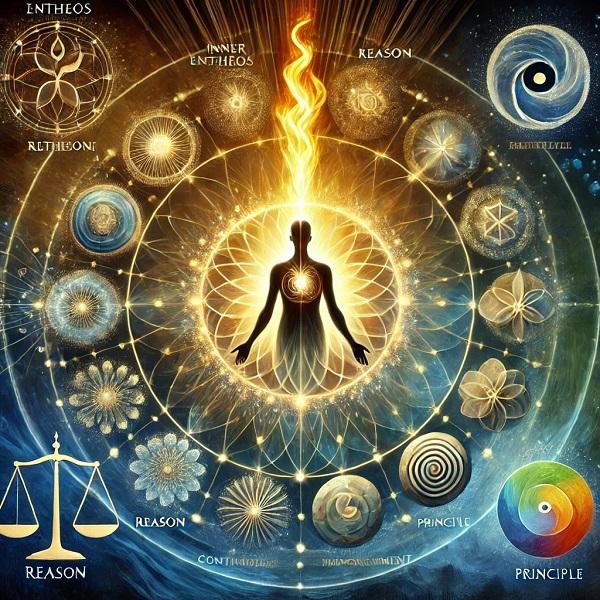
Entheos
Entheos is the spirit within. It is the root of the word enthusiasm — not as it is commonly used, to mean eagerness or excitement, but in its original sense: the animating force that lives inside, the fire that sustains what the will alone cannot.
It is not motivation. Motivation comes from outside — from reward, from pressure, from the need to be seen moving. Entheos comes from within, and it is of a different order entirely. It does not deplete in the way that external drive depletes. It does not depend on circumstances remaining favorable or on results arriving on schedule. It burns from a place that circumstances cannot easily reach.
But it cannot be summoned at the beginning. Entheos without a sound path does not illuminate — it intensifies what is already in motion. And what is already in motion may be moving in entirely the wrong direction, however sincerely, however powerfully felt.
This is why it comes last. When Awareness has opened the eye, when Reason has directed the gaze, when the Pareto Principle has found the steps that carry the most, and when Kaizen has begun its patient and faithful repetition — only then can Entheos be trusted. It does not lead. It sustains. It is the warmth that keeps the path alive from within, long after the feeling that began the journey has passed.