Introduction
What is observation? At its simplest, observation is seeing. But at its deepest, observation is trust — the ability to look at a person, a path, or a promise and know whether it will hold or fade.

We like to believe we are good observers. We notice when someone is lying. We sense when a relationship is drifting. We trust our instincts. But observation is not just about seeing what is loud and obvious. It is about seeing what is almost invisible — the small angle, the gentle slope, the quiet deception that looks, at first, exactly like companionship.
This article explores a single geometric metaphor for observation: the difference between a triangle and a trapezoid. One shape is honest. The other breaks your heart. Learning to see the difference is what observation truly means.
The Triangle: Honest Divergence
What is observation if not clarity? The triangle offers no confusion.
Stand at any point on a triangle. Look at the lines that extend from you. They spread wide — immediately, openly, without apology. There is no secret here. These two paths are going in different directions. The triangle never pretends otherwise.
Stand at any point and the lines make no secret of themselves — they diverge, openly, without apology. You can see it immediately. These two paths are going different ways. The triangle doesn’t pretend otherwise. It spreads its lines apart like arms held wide, declaring from the very first step: we are not the same direction.
This is the first lesson of observation: some things show you the truth immediately. A triangle does not need to be studied. It does not hide. Its honesty is its structure. You may not know exactly where each line ends, but you know, plainly, that they end apart.
In human terms, the triangle is the friend who tells you directly, “I cannot be there for you right now.” It is the job that states its limitations upfront. It is the romantic interest who says, plainly, “I am not looking for the same thing you are.”
Does that hurt? Perhaps. But the triangle never breaks your heart — because it never made you a promise it could not keep.
The Trapezoid: The Illusion of Shared Direction
What is observation when it fails? It fails when we mistake a trapezoid for a set of parallel lines.
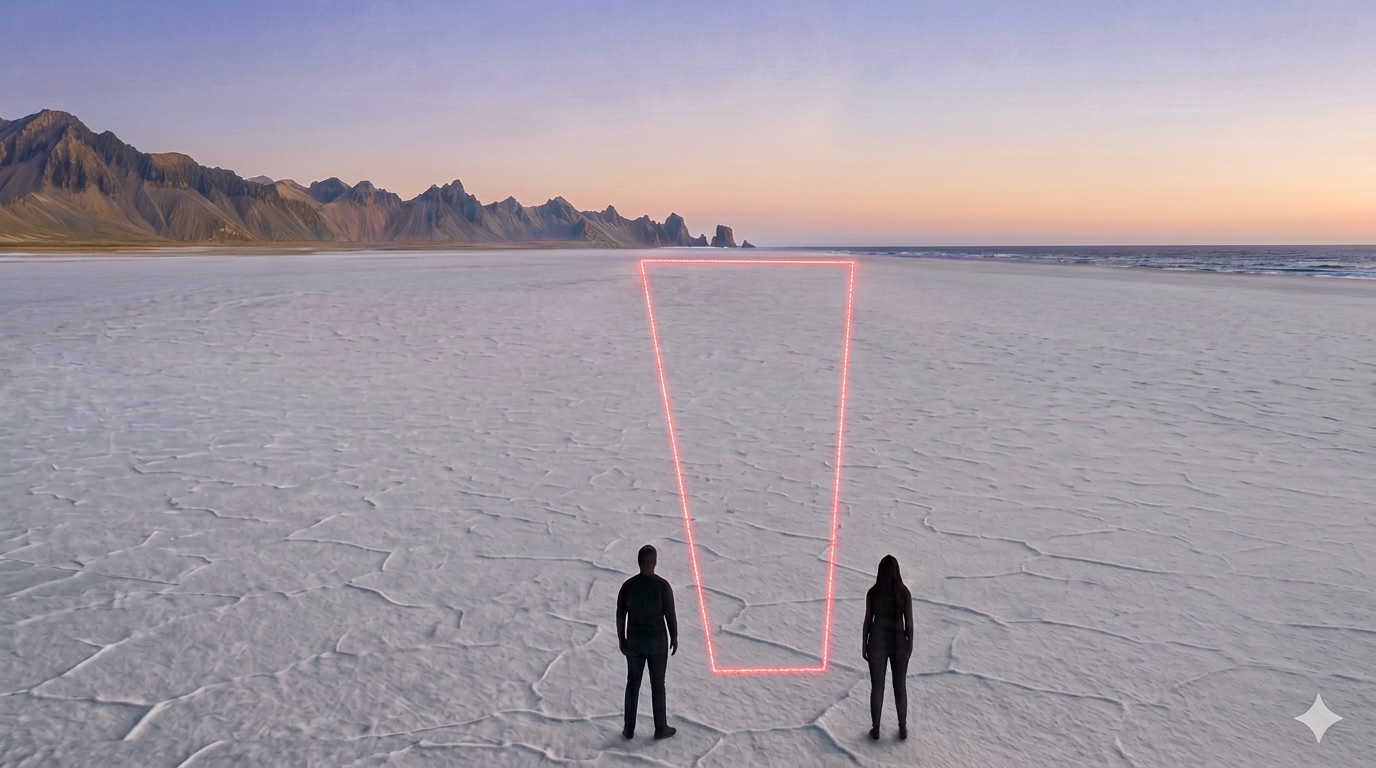
A trapezoid is a subtle shape. At first glance, it looks almost like a rectangle or a long, stretching square. Two friends stand at one end of its base, each in their own lane. They begin walking forward, each following the line beneath their feet.
And here is where the deception begins.
To each person, the other does not seem far away. The lines angle outward only slightly — just a few degrees. Close enough that from where you stand, you almost feel parallel. You almost feel like companions headed somewhere near the same place.
The trapezoid doesn’t lie boldly. It lies gently. It mimics the look of togetherness while quietly, incrementally, pulling you apart.
This is the geometry of broken trust. The trapezoid never tells you, “We are separating.” Instead, it gives the illusion of shared direction. You believe you are walking toward the same horizon. You believe the small distance between you is just that — small. Temporary. Insignificant.
But a few degrees, sustained long enough, become a different city. A different country. A different life.
You each followed your line faithfully — honestly, even — and still, you ended up in entirely different worlds.
The Deceptive Trapezoid
The Deceptive Trapezoid
The triangle speaks plain and clear —
No promise made, no hidden fear.
Its lines spread wide; you see the end.
No path pretends to be a friend.The trapezoid, with softer art,
Keeps two friends close before they part.
A few degrees — then worlds, not near.
It breaks the trust that once felt dear.
Why the Trapezoid Is More Dangerous Than a Lie
A direct lie is a triangle. Someone tells you, “I do not want to walk with you.” That hurts, but it clarifies. You adjust. You find another path.
The trapezoid never lies directly. It does not need to. It simply arranges the geometry so that you believe you are walking together — until you look up one day and realize you are alone.
This is why the trapezoid is so much more damaging than the triangle. The triangle never promised you anything. The trapezoid promised you almost.
And almost, followed far enough, is the longest distance there is.
Consider real-life examples of the trapezoid:
- Friendships that fade slowly. No fight. No goodbye. Just a few degrees of drift over years until you realize you no longer know each other.
- Relationships that never quite commit. You are together, but not quite. You share a direction, but not quite. The angle is so small you convince yourself it is parallel — until the gap becomes unbridgeable.
- Work partnerships that start with shared vision. The goals align at first. But over time, each person’s priorities angle away, silently, until you are building two different futures.
In every case, the betrayal is not a lie. It is an illusion of togetherness that was never geometrically true.
What Is Observation? The Skill of Seeing the Angle
Now we return to the central question: What is observation?
Observation is the ability to see the angle before the distance becomes unmanageable.
A poor observer looks at a trapezoid and sees two friends walking side by side. A skilled observer looks at the same shape and asks: Are these lines truly parallel, or do they only appear that way from where I am standing?
This is not paranoia. This is geometry.
To observe well is to ask, at every juncture:
- Is this path honestly diverging, or is it pretending to run alongside me?
- Is this person showing me their angle, or am I seeing only what I want to see?
- Am I walking with someone, or am I walking near someone while the ground beneath us quietly splits?
These are not easy questions. But they are the questions that separate observation from assumption.
How to Apply This to Your Life
- Honor the triangle in your own life. When you know you are diverging from someone, do not mimic the trapezoid. Speak plainly. Let them see the truth.
- Learn to spot the trapezoid early. Ask yourself: Are we truly heading in the same direction, or does it just feel that way because we started close?
- Do not blame yourself for missing the angle. The trapezoid is designed to deceive. Its slope is gentle. Its illusion is convincing. You were not naive — you were human.
- Trust the triangle more than the promise of “almost.” A triangle may disappoint you, but it will never betray you.
Conclusion
What is observation? It is the practice of seeing not just what is in front of you, but what is between you and another person.
The triangle teaches us that honesty is visible. Its lines spread wide. Its divergence is declared. It may not offer companionship, but it never pretends to offer what it cannot give.
The trapezoid teaches us that deception is not always a lie. Sometimes it is just a few degrees — just enough to feel like company, just enough to break a trusting heart.
And the longest distance is not a thousand miles. It is almost — followed long enough until there is no almost left, only the quiet realization that you were never walking together at all.
So observe carefully. Trust what spreads wide. And when a shape promises you almost, remember: the honest shape never breaks your heart. Only the deceptive one does.
FAQ
What is observation in simple terms?
Observation is the ability to see what is actually there — not just what appears to be there. It means noticing small angles, hidden divergences, and the difference between honest separation and deceptive closeness.
How does a triangle relate to observation?
A triangle represents honest observation. Its lines spread openly and immediately. You can see divergence from the first step. The triangle never hides its direction.
Why is a trapezoid deceptive?
A trapezoid gives the illusion of parallel lines. Two paths start close and angle away so gradually that you believe you are walking together — until the distance becomes too wide to ignore.
What does “almost breaks the trusting heart” mean?
It refers to the specific cruelty of the trapezoid. Unlike a triangle, which never promises togetherness, a trapezoid promises almost — close enough to believe in, far enough to destroy trust over time.
How can I spot a trapezoid in real life?
Look for relationships, friendships, or partnerships where you feel you are heading in the same direction — but the distance between you keeps growing, silently, without explanation. That is the trapezoid at work.