Imagine standing on a street corner in a bustling city. Next to you is a seasoned detective, a landscape architect, and a stray dog. A car speeds past, splashing water from a muddy puddle onto the sidewalk. You see an annoying inconvenience. The detective notes the license plate prefix and the driver’s erratic grip on the steering wheel. The architect notices how poorly the curb drains water into the sewer system. The dog simply jumps back, responding to the sudden threat of loud noise and flying liquid.

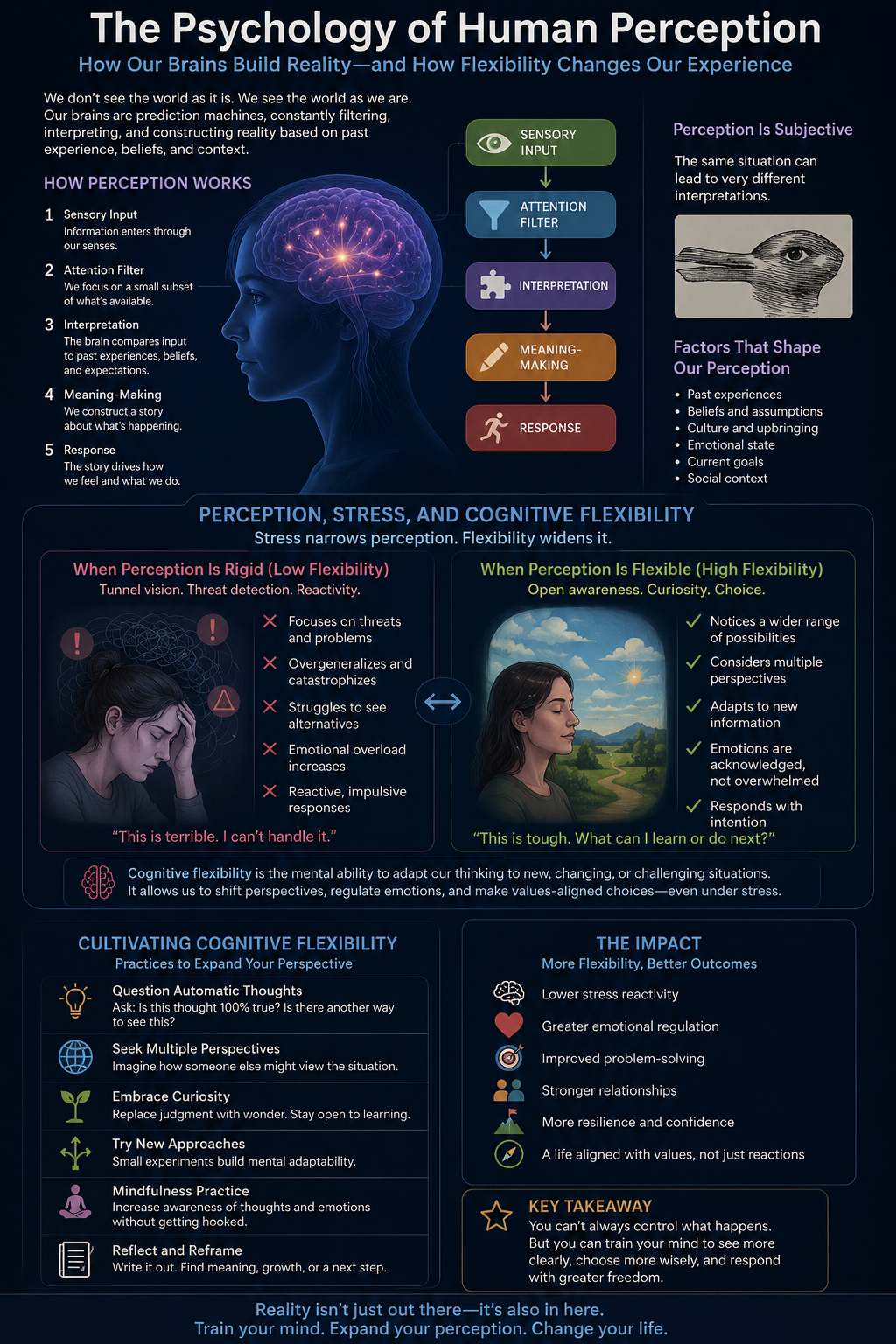
We like to believe we are objective observers of our lives. We treat our eyes like high-definition lenses and our memories like flawless digital drives. But neuroscience tells a radically different, far more humbling story. Your brain does not record the world as it exists; it structures an interpretation based on what it expects to see, what it prioritizes, and what it needs to navigate. This deeply subjective process of translating raw sensory data into a meaningful inner experience is what defines human perception.
When you realize that your experience of reality is a highly personalized interpretation, your relationship with your thoughts, your arguments, and your anxieties shifts. You stop demanding that the world conform to your view, and you start wondering how your view was built in the first place.
Beyond the Mechanical Record
For decades, science classrooms taught a straightforward model of human vision. Light bounces off an object, passes through the lens of your eye, hits the retina, and sends an electrical signal to the visual cortex. It sounds mechanical, like a smartphone taking a photo.
But if your brain operated like a camera, you would constantly be disoriented. Every time you blinked, the feed would cut to black. Every time you turned your head rapidly, the image would blur into an unreadable smear. Furthermore, your retina actually has a massive blind spot where the optic nerve connects to the eye, right in the center of your field of view.
Yet, you don’t see a black hole in the middle of your living room. Why? Because your visual system naturally smooths over the gap using surrounding context, effectively ignoring the lack of sensory information to maintain an uninterrupted field of view. The brain isn’t actively painting a detailed landscape over the void; it simply omits the absence of data from your conscious awareness.
This basic mechanism demonstrates a broader truth: a significant portion of what you experience is a neurological construction. The brain is not a passive receiver of information; it is an active prediction engine. It sits in a dark, silent skull, receiving nothing but ambiguous electrical buzzes from your nerve endings. To make sense of those buzzes, it relies heavily on your past experiences. If you have spent your whole life around friendly dogs, a sudden bark triggers an interpretation of playfulness. If you were bitten as a child, the exact same auditory frequency triggers a shot of adrenaline and a look of terror. The raw sensory input is identical, but the internal perception is entirely distinct.
This predictive architecture scales all the way up from basic visual tricks to our most complex cultural experiences. Researchers at institutions like the Max Planck Institute for Empirical Aesthetics, for instance, study how these internal, predictive interpretations dictate why two people can look at the exact same design, painting, or physical environment and experience entirely different aesthetic and emotional reactions.
The Hidden Filters That Guide Your Awareness
If our minds are constantly predicting the world rather than recording it, what tools do they use to manage these predictions? The answer lies in a complex web of internal filters that we spend our lifetimes building without realizing it.
The first major filter is selective attention. Your sensory organs are constantly flooded with an immense volume of environmental noise, but conscious processing operates through a remarkably narrow bottleneck. Because your working memory can only handle a fraction of this incoming data at any given moment, your brain relies on top-down attentional networks—circuits involving the prefrontal cortex—to act like a moving spotlight, prioritizing what is relevant and suppressing the rest.
When you decide you want to buy a red car, your brain primes your visual processing centers to flag that specific visual profile. The red cars didn’t magically multiply on the highway; your frontoparietal control network likely shifted its attentional biases, lowering the threshold for that data to breach your conscious awareness. This quirk of selective attention—often called the “frequency illusion”—demonstrates how heavily our immediate cognitive priorities bias what we notice in our environment.
The second filter is your internal physiological and emotional state. Rather than viewing the world neutrally, our subjective outlook is deeply anchored in interoception—the brain’s continuous monitoring of internal bodily signals. When you are chronically fatigued, sleep-deprived, or metabolically depleted, this internal feedback shifts your baseline affective state. This physiological drag significantly increases the subjective effort required to engage with your environment, lowering your tolerance for daily stressors and altering your cognitive appraisal of challenges.
More profoundly, your emotional state alters how you decode social data. Clinical studies in neuroimaging indicate that during periods of acute stress or anxiety, neural networks sensitive to environmental salience and ambiguity—including the amygdala—show heightened reactivity. Under this influence, the mind is significantly more likely to resolve ambiguous social cues, such as a completely neutral facial expression, as a sign of potential hostility. The expression on the other person’s face hasn’t changed; your internal baseline has altered how your brain resolves the ambiguity.
Finally, our deeply ingrained beliefs act as a powerful confirmation filter. While we are capable of objective reasoning, our minds frequently tilt toward processing data that aligns with existing expectations. If you wake up anticipating a miserable, stressful day, your brain’s attentional gating is more likely to flag the slow barista, the red lights, and the curt email from your boss. Meanwhile, it easily overlooks the stranger who held the door open or the pleasant morning breeze. You exit the day thinking, I knew it, I was right, completely unaware that your cognitive bias curated that specific experience for you.
Why Different Perspectives Cause Social Friction
Understanding this biological subjectivity is not just an academic exercise; it is the core of human empathy. Most interpersonal conflicts—whether between romantic partners, co-workers, or political factions—do not happen because one side is inherently malicious or broken. They happen because both sides are operating with entirely different sets of data provided by their internal programming.
Consider a classic workplace scenario. A manager walks into a meeting room and sharply asks, “Why hasn’t the project report been finalized yet?”
One employee, who grew up with an overly critical, volatile parent, interprets the manager’s tone as an existential threat. Their heart rate spikes, their defense mechanisms go up, and they respond with hostility or shut down completely. To them, the manager is an abusive bully.
Another employee, who grew up in an environment where direct, blunt communication was valued as a sign of respect and efficiency, hears the exact same question and thinks, Oh, the boss is under pressure and wants a quick update. They provide a concise status report without a single drop of emotional distress.
Neither employee is lying. Both are reacting truthfully to the reality presented to them by their minds. When we insist that our view is the only objective reality, we lose the ability to connect with others. We look at someone with a different viewpoint and assume they are being deliberately difficult, when in reality, their mental machinery is simply synthesizing a different set of past inputs. To bridge this gap, we must learn to pause and investigate the underlying mechanics of individual perception.
Cultivating Flexibility in Default Mental Filters
The good news is that your brain’s predictive models are not entirely rigid. While popular psychology often overpromises how easily we can willfully deploy “neuroplasticity” for self-mastery, cognitive behavioral literature demonstrates that deliberate, repeated shifts in attention and behavior do gradually alter default neural responses over time. You cannot rewrite your neural circuitry overnight through sheer willpower, but you can build cognitive flexibility by manually interrupting automatic habits.
- Practice Cognitive Reappraisal: When someone cuts you off in traffic, your immediate automated response might be an assumption of malice. Instead of accepting that thought as an absolute baseline truth, intentionally introduce alternative scenarios. They might be rushing to a medical emergency, or your car was simply in their blind spot. By forcing your mind to entertain alternative narratives, you break the rigid authority of automatic cognitive habits.
- Diversify Daily Inputs: If you only read the same commentaries, talk to the same social circle, and follow identical routines, your brain’s predictive models become brittle and narrow. Stepping outside your comfort zone—whether by consuming unfamiliar literature or listening deeply to a perspective you disagree with—forces your neural networks to accommodate more complex data.
- Prioritize Physiological Regulation: Because our internal interoceptive state heavily shapes our emotional outlook, managing basic physical needs is the most direct way to alter how you experience a stressful day. A well-rested nervous system naturally processes a minor inconvenience as a brief disruption, whereas a chronically depleted body registers that exact same inconvenience as a threat. By stabilizing your physiology, you directly stabilize your psychological perception.
Conclusion: The Agency of a Questioning Mind
Living with an awareness of your mind’s subjective nature can feel destabilizing at first. It forces you to admit that your memories, quick judgments, and deepest convictions are far more fragile than you might care to confess.
But if you lean into that discomfort, it transforms into a profound sense of psychological agency. You may not be the omnipotent author of the physical world, but you are also not a helpless prisoner to your default conditioning. You have the capacity to pause, step back, and observe the machinery at work.
The next time you find yourself trapped in anger, anxiety, or absolute certainty during a disagreement, take a breath and remember the imperfect lens inside your head. The world outside may be complex and chaotic, but understanding how your internal perception is assembled gives you the power to question it. That persistent curiosity, rather than a forced “positive mindset,” is the real foundation of psychological maturity.