Entheos : The Fifth Principle
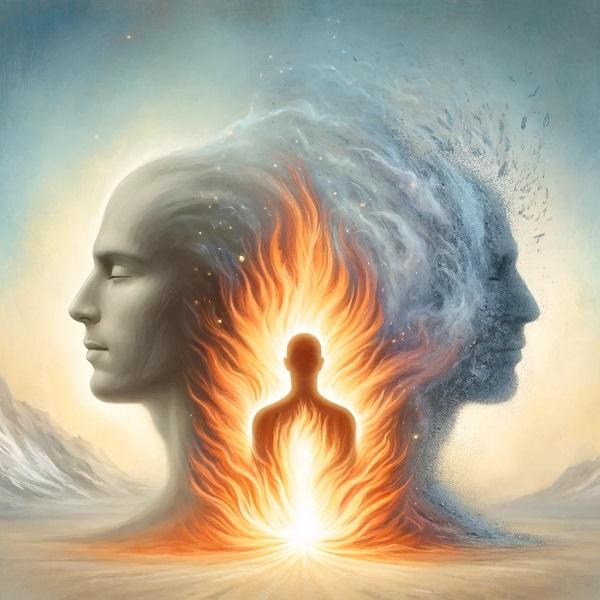
Entheos is not a word that translates cleanly. The spirit within — that is the closest the English language comes, and it does not come very close. It is the root from which enthusiasm grew, but what it carried in its original sense has been largely lost in that growth. Enthusiasm, as it is commonly used, describes a feeling — heightened, energetic, often temporary. Entheos describes something older and quieter than that. The animating force that lives at the center of a person. The fire that does not flicker with circumstance.
It is not motivation. The distinction matters more than it might appear to.
Motivation is a response. It rises when conditions are favorable — when the goal feels close, when results are visible, when others are watching, when the feeling of momentum is present. And it falls when those conditions change. A person running on motivation runs well when the wind is behind them. When it shifts, the running becomes harder to explain to themselves.
Entheos is not a response to conditions. It does not rise and fall with results. It does not require an audience or a visible return. It burns from a place that circumstances cannot easily reach — and this is what makes it different in kind, not merely in degree, from anything that comes from outside.
But it cannot be summoned at will. And this is where its nature must be understood carefully.
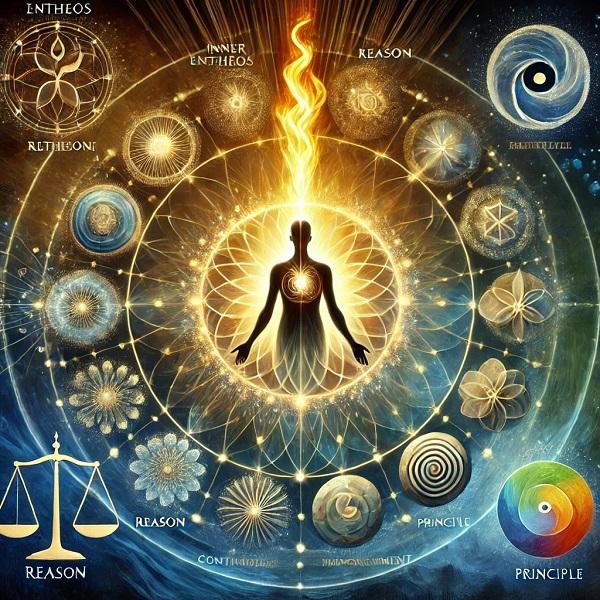
Entheos without a sound path does not illuminate. It intensifies what is already in motion. And what is already in motion may be moving in entirely the wrong direction — not from lack of sincerity, not from lack of fire, but from lack of the ground that should have been laid first. A person fueled by Entheos before Awareness has seen clearly, before Reason has confirmed the path, before the Pareto Principle has found what carries the most, before Kaizen has begun its patient work — that person moves with great force toward whatever they happen to be facing. The fire is real. The direction may not be.
This is why it comes last. Not because it is least — but because it is most powerful, and power without direction is not a gift.
What makes Entheos available — what clears the ground for it — is a particular kind of freedom. Not the freedom that is won externally, though that struggle has its own dignity. The freedom that matters here is inner. It is the mastery of what moves beneath the surface — the anger that distorts perception, the vanity that substitutes approval for truth, the fear that presents itself as caution. These are not weaknesses to be condemned. They are passions of the mind, and they are powerful. As long as they govern unchallenged, the spirit within remains obscured — not absent, but unreachable.
This inner freedom is not arrived at in a single insight. It is cultivated — through the regular practice of stillness, through meditation that does not seek to empty the mind but to observe it honestly, and through the patient work of returning, again and again, to what is actually present rather than what the passions of the mind insist is there. The fire does not ignite in the noise. It is found in the quiet.
This inner freedom has a companion understanding — that thoughts, words, and actions do not disappear into a neutral world. They create a reality that mirrors back. What is held consistently in the mind, what is expressed repeatedly in words, what is acted upon day after day — these shape the conditions of a person’s life with more fidelity than most are comfortable acknowledging. When this is ignored or misread, the same patterns repeat, the same frustrations return, and the same walls appear in different rooms. When it is understood and worked with consciously, something shifts.
The practice that makes this understanding useful is multi-sensory — not merely thinking about a different outcome, but inhabiting it across as many dimensions of experience as possible. What it looks like. What it feels like in the body. What it sounds like. What it requires, concretely, of the person standing in it. A goal held only as an idea remains an idea. A goal inhabited with the full attention of the senses begins to reorganize the inner world around it — and the inner world, reorganized, begins to express itself differently outward.
And what allows that change to hold is harmony. A person experiences what they are in alignment with — not what they wish for, but what they are. As the inner world shifts through practice, what once required effort begins to require less. The alignment, once established, sustains itself. Entheos is not the beginning of this process. It is what the process, faithfully followed, makes possible.
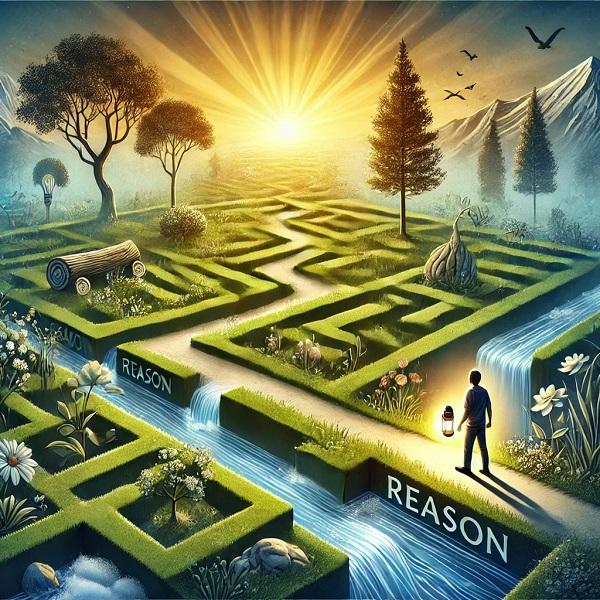
When the ground has been prepared — when the path has been seen, confirmed, concentrated, and is being walked faithfully — something becomes available that was not available before. Not the forced enthusiasm of someone who has convinced themselves to feel motivated, but the quiet, steady warmth of a fire that has found its proper use.
Entheos reaches into the spiritual life as a deep and sustaining sense of rightness — the felt knowledge that what is being done is aligned with something true. Not excitement. Not the high of a new beginning. Something steadier than that. The kind of inner confirmation that does not need external validation because it does not come from external sources.
In the mental life, it is clarity that does not depend on mood. The mind fueled this way does not require ideal conditions to think well. It returns, again and again, to what it knows to be true — not because it has forced itself to, but because the connection to that truth has been kept alive from within.
Food, once understood rather than managed, becomes something different entirely. What the body actually needs and what a person finds themselves wanting begin, over time, to move toward each other. This is not discipline maintained by effort. It is something that grows naturally from understanding.
Movement sustained this way does not require willpower. It becomes something a person returns to willingly — not because they have committed to a program, but because they have discovered what their body is genuinely capable of and find, day after day, that the discovery is worth repeating.
The emotional life changes last and most quietly. The difficult moment still arrives. The familiar difficulty still lands in its familiar way. But beneath it, something holds — not because the person has hardened themselves against it, but because the fire within has not gone out. And a person who still has their fire can meet almost anything.
This is what Entheos sustains. Not the feeling that began the journey — that feeling will change, as all feelings do. What it sustains is the journey itself. The path, once wisely chosen and faithfully walked, is kept alive not by what comes from outside but by what burns within.
And as it burns, the person walking the path becomes more fully themselves — not arriving at something new, but uncovering what was always there, waiting for the right conditions to be expressed.