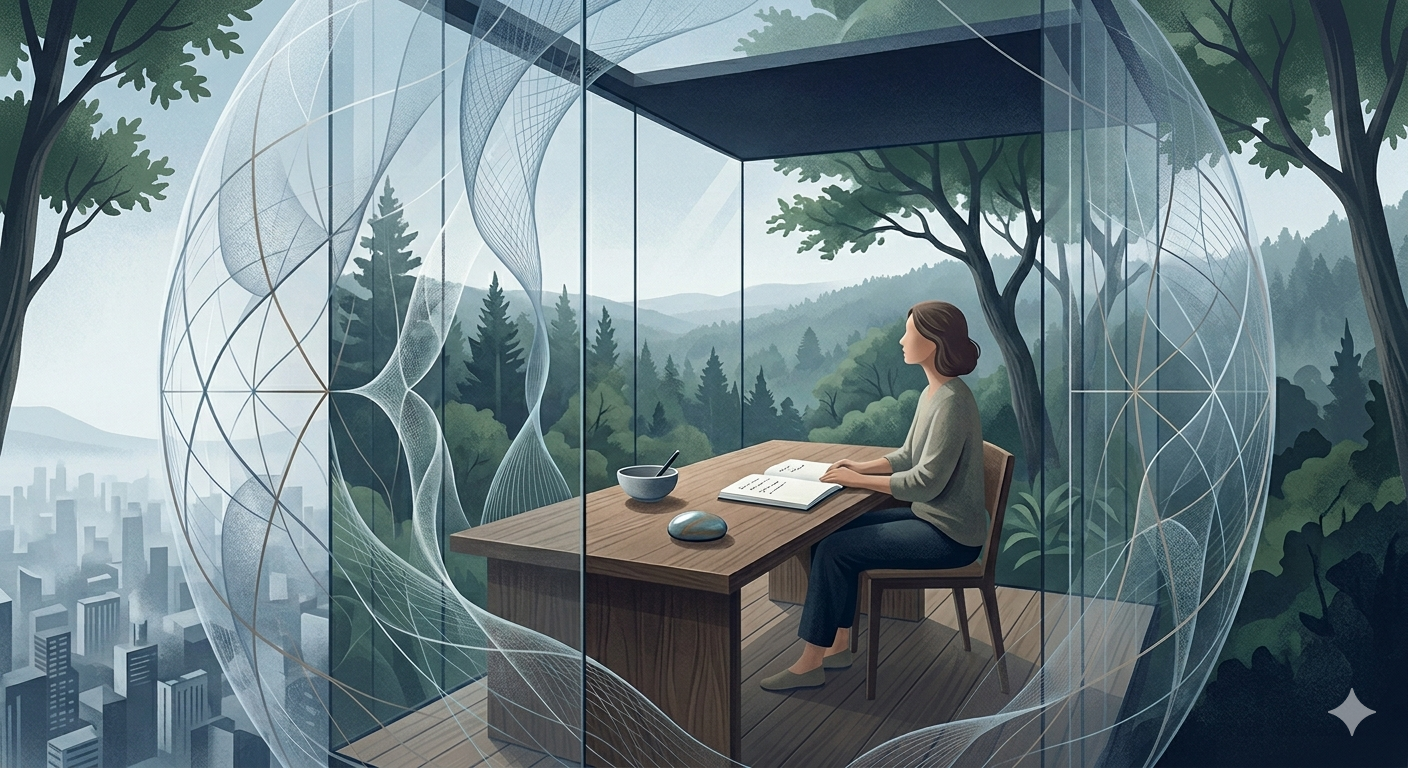
We often speak of self-discipline as if it were a trial of character. In the popular imagination, the disciplined individual is a figure of rigid iron—someone who, through sheer, muscular force of will, beats their impulses into submission. We see the morning runner, the silent meditator, or the writer at their desk at dawn, and we project a narrative of struggle: a battle between the “good” self and the “lazy” self. If we fail to sustain our habits, we interpret it as a personal failing, a deficit in our moral fiber.

But what if we have been looking at this all wrong? What if the exhaustion we feel in trying to “be disciplined” is not a sign of our personal weakness, but a sign that we are fighting the wrong war?
The Thermodynamic Reality of Our Attention
To understand why “willpower” feels so draining, we must turn to a principle of physics: the Second Law of Thermodynamics. This law dictates that in any closed system, entropy—or disorder—always increases. Things left to themselves trend toward chaos. A room left unattended gathers dust; a garden left untended returns to the wild.
Our internal state, if left to the mercy of the modern world, operates on this same principle. We live in an environment designed to disperse our focus, designed to pull our energy into a thousand different directions until we are left, at the end of the day, feeling scattered and drained. To view the concept of discipline through the lens of thermodynamics is to realize that it is not a battle of the will; it is an act of environmental design. We are not trying to “win” a fight; we are trying to lower the systemic entropy that makes focus so difficult to maintain.
The Illusion of Constant Choice
The primary reason our traditional attempts at personal growth collapse is that we rely on “willpower” to combat entropy. We assume that being disciplined is the act of constantly saying “no” to distractions. We imagine ourselves standing at the gates of our minds, pushing back against a relentless tide of smartphone notifications, social obligations, and minor, low-stakes decisions.
However, willpower is a finite, high-energy resource. When we force ourselves to exert it constantly, we are essentially trying to power a city by burning the furniture. We are consuming the very energy we need for creative and contemplative work just to keep our surroundings from collapsing into disorder.
The most disciplined individuals—the artists, the thinkers, and the makers who seem to move through the world with such grace—are not the ones with the most “willpower.” They are the ones who have mastered the discipline design required to protect their cognitive bandwidth. They understand that if they leave their energy vulnerable to the currents of chaos, chaos will win. Instead of fighting the noise, they build a structure that makes the noise irrelevant.
Discipline as an Act of Mercy
Consider the way a master carpenter treats their workshop. They do not spend their day looking for tools; the tools have a home. They do not make a thousand decisions about where to place a chisel; the environment has already made those decisions for them. By creating a system of constraints, the carpenter frees their mind to focus entirely on the grain of the wood and the integrity of the joint.
This is the secret of true discipline: it is a form of deep, intellectual mercy.
When we curate our lives—when we decide, once and for all, how we will spend our mornings, where we will place our devices, or which invitations we will decline—we are not restricting ourselves. We are protecting ourselves. We are lowering the energy cost of living so that we can afford the high cost of thinking. Like a well-built vessel holding back the ocean, our internal structures allow us to contain our intentions, keeping them safe from the entropic forces that would otherwise wash them away.
Finding Equilibrium in a Noisy World
We often mistake the state of “flow” for a mystical or accidental occurrence. But flow is simply the natural byproduct of a system in equilibrium. It is what happens when the external environment is perfectly calibrated to support the internal task. When the noise is silenced, when the constant need for choice is removed, and when the friction is minimized, the mind does not have to “try” to focus. It simply does.
True discipline is the creation of this silence. It is the wisdom to realize that we cannot outrun the chaos of the world, but we can build a sanctuary within it. It is an act of love for the work we want to do and for the person we are becoming.
When you sit down to work tomorrow, do not ask yourself if you are “disciplined” enough to finish. Instead, look at your environment. Ask yourself: What entropy am I allowing into this space? What choices am I being forced to make that I should have already resolved?
Discipline, in this light, is not the triumph of the soldier. It is the triumph of the architect. It is the steady, quiet work of creating the conditions under which you are most likely to flourish—not by force, but by design. By curating your world, you allow your best intentions to move from a state of fragile potential into the realm of lasting reality.
Strategic Application: Practical Shifts for Sustainable Focus
To move from the exhaustion of willpower to the elegance of discipline design, consider these practical shifts:
- From Task-Management to Energy Audits: Instead of merely tracking how much work you do, track where your energy “leaks.” Identify the moments where you have to make a choice—such as deciding whether to check email or choosing what to work on next—and eliminate that choice by creating a default procedure. This reduces decision fatigue, a primary driver of entropy.
- Design for Defaults: Environmental design beats willpower every time. If you want to read more, keep a book on your pillow. If you want to write more, keep your laptop open to your draft. Remove the friction that requires an active choice to overcome. By making the right path the “path of least resistance,” you conserve the energy necessary for high-level cognitive work.
- The Contemplative Pause: Before beginning any significant work, take a moment to clear the physical and digital “noise” around you. See this as a “cooling period” for your system—a necessary step to lower the entropy of your immediate surroundings so your focus can naturally settle.
True discipline is not about doing more; it is about creating a space where “doing” becomes the only logical outcome of your environment.
For further exploration of how systems and constraints shape our lives, I recommend The Laws of Simplicity by John Maeda, which articulates how the thoughtful application of design and constraint can lead to profound clarity.