The Bard’s Tale of the Inner Chariot
A Parable of Wisdom vs Knowledge
Tell me, traveler — have you ever wondered why strength alone does not bring victory? Why the swiftest falter, and the fiercest fail? Why those who know themselves may still be strangers to their own souls?
The chariot waits upon the sand,
Four horses yoked by mortal hand.
They strain, they pull, they fight for place—
The race of life, the timeless race.
To name the horses is not enough—
The wise must know the deeper stuff.
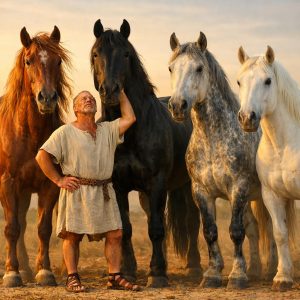
There was once a master of horses, proud of his steeds. Their coats shone in the sun, their hooves struck sparks from the stone. He knew their names, their bloodlines, their tempers. He could recite their every strength. And he boasted to all: “None can rival these horses. I know them completely. With them, no race can be lost.”
Yet when the contests came, he found only dust and defeat. His chariot stumbled, his wheels wavered, and others claimed the crown. In anger he cried, “What curse is this? I know my horses — how can the strongest steeds betray me?”
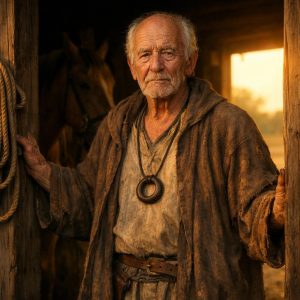
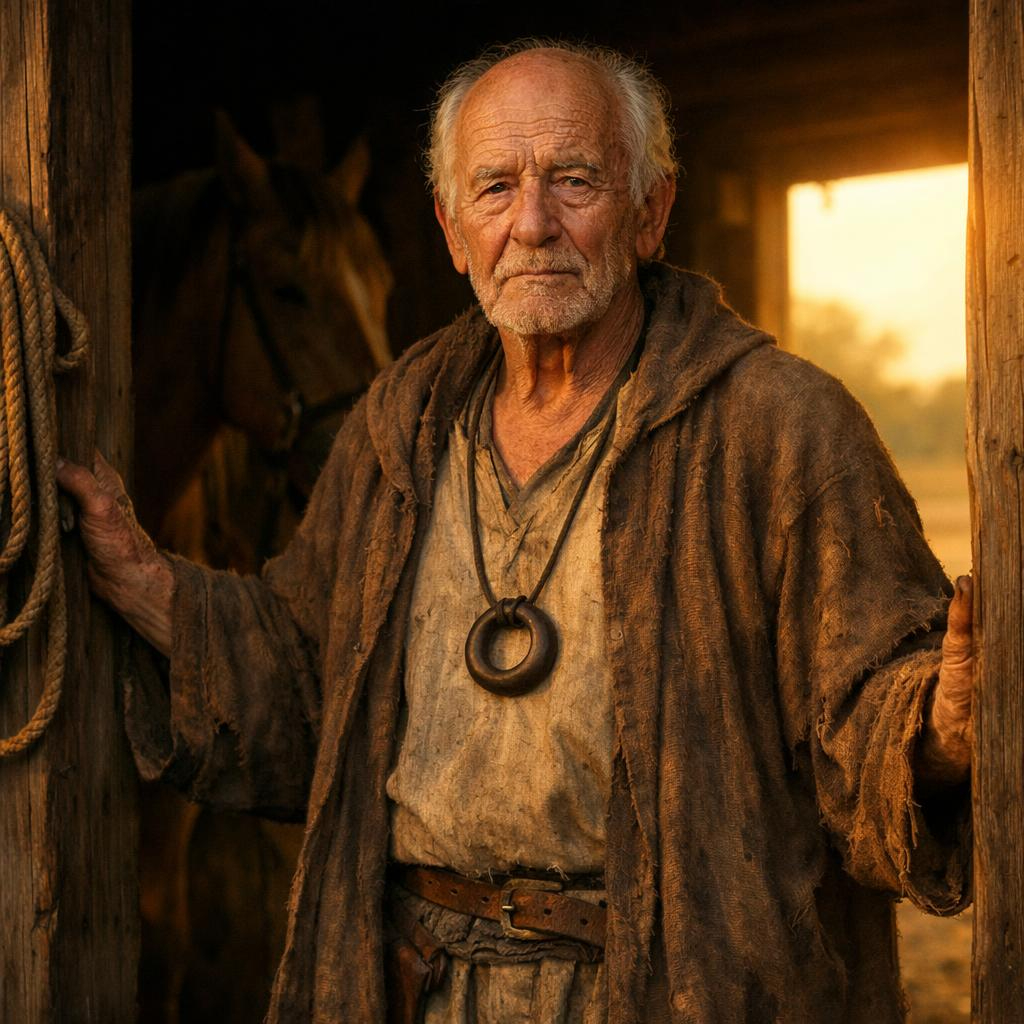
From the shadows stepped an elder horseman, robes worn by years, hands thick with rope and leather. Around his neck hung a simple cord threaded through a wooden ring — smooth and dark from decades of turning between his fingers. His eyes carried the patience of one who had studied beasts longer than the master had drawn breath. He spoke not loudly, but with such certainty that the stable itself seemed to hush.
“The curse is not in the horses,” the old man said. “It is in their order. You know what they are. You do not know where they belong. The fiery one you’ve set at the flank pulls against the others. The steady one, buried at the back, longs to lead. They fight each other, not the course. You have knowledge of the horses. You lack wisdom of the team. Align them rightly, and they will run as one.”
The master bristled. “You dare to teach me of my own? I know these horses.”
The horseman’s gaze was unwavering. “You know their names. You do not know their places. Knowledge tells you what you have. Wisdom tells you what to do with it. I dare to tell you truth. Strength without harmony is ruin. Place them as they are meant to be, and you will taste victory.”
The team aligned will run as one,
Their strife resolved, the course is won.
No gift alone can seize the prize,
But harmony makes strength arise.
To know each horse is common ground—
To place them rightly: wisdom found.
The master’s pride fought against the elder’s words. His lips pressed tight, his heart boiled with defiance. He turned away, jaw set like stone.
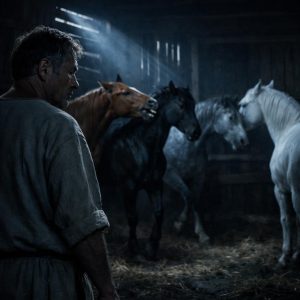
But that night, alone in the stable, he could not escape the question. He watched his horses in the dark — their restless shifting, the way the fiery one nipped at the steady one’s neck, the way the nimble pair pulled apart rather than together. He had always named their strength. Now, for the first time, he saw their war.
And in seeing it, he saw himself: his own mind darting one way, his heart another, his hands working without aim, his deeper knowing buried and ignored. He had known his horses. He had not understood them. He had knowledge. He lacked wisdom.
The pride that had armored him for years cracked quietly in that dark stable. Not from shame. From recognition.
At dawn, against himself, he gave the order.
The fiery horse was set in front, the strong one to anchor, the nimble ones to balance the line. He had known these facts before. But now he understood them. And when the race came again, the dust no longer blinded, the wheels no longer swayed. The chariot flew swift and straight, and triumph was his.
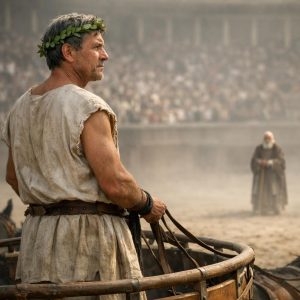
The crowd roared. The wreath was placed upon his brow. Yet the master did not raise his fist or cry out in glory. He stood still upon the chariot, reins loose in his hands, and looked back across the sand — to where the elder horseman stood alone at the edge of the crowd.
The old man touched the wooden ring at his throat and gave a single nod.
And the master understood: knowledge had shown him what he had. Wisdom had shown him what to do with it. The wreath was not the prize. The ordering was.
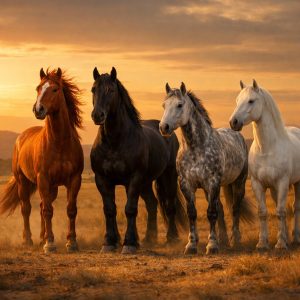
So it is with the chariot of the self. Each of us holds four unseen horses:
The Mind, clever and darting.
The Emotion, fiery and restless.
The Action, steady and enduring.
The Spirit, quiet and guiding.
We boast of them as the master did. We know they exist. One praises intellect, another passion, another endurance. This knowledge is common. Nearly everyone can say: I think, I feel, I act, I sense something deeper. Yet when they are wrongly placed, the chariot falters.
But knowledge of the four is not wisdom of the four.
Four horses pull the soul’s own frame,
Not one alone can win the game.
In order set, their power flows,
And to the crown the chariot goes.
To know you have them — that is start.
To place them rightly — that is art.
Watch how we stumble:
We act without contemplating. Action charges forward while Mind and Spirit stand unharnessed. We stay busy, but go nowhere. We move without aim, and call it progress.
We let Emotion break the rules of the Mind. The fiery horse stampedes. We know better, but we feel louder. Anger speaks before thought can intervene. Desire overrides judgment. We wake in the wreckage and say, I knew I shouldn’t have.
We let the Mind suppress Emotion. The clever horse becomes tyrant. We rationalize ourselves out of what we genuinely feel. The heart goes silent. Something essential dims, and we call it maturity.
And through it all, Spirit goes unheard. The quiet guide, the one who knows why we run at all, gets buried beneath the noise of the other three. We lose direction not because we lack strength, but because we have silenced the one who knows the way.
This is not ignorance. We know we have these four. The struggle is not knowledge. The struggle is arrangement.
If Emotion charges ahead, storms scatter the path. If Mind runs without Spirit, cleverness turns to cunning. If Action moves without aim, strength is wasted in circles. But when Spirit guides, Mind plans, Emotion fuels, and Action carries forth — the chariot surges steady and true.
The mind must see, the heart must feel,
The hands must act, the spirit steer.
When each obeys its rightful part,
The crown of triumph shall appear.
We may know well what gifts we own,
But wisdom sets them on their thrones.
This is the difference:
Knowledge says: I have a mind. Wisdom says: Let it see, not rule.
Knowledge says: I have emotions. Wisdom says: Let them fuel, not steer.
Knowledge says: I can act. Wisdom says: Let action serve, not lead.
Knowledge says: I sense something deeper. Wisdom says: Let that deeper knowing guide the rest.
Thus the lesson stands: victory is not in the power of the horses alone, but in their order. Nearly all possess the four. Few have learned to place them rightly.
The old horseman, watching the master’s stillness amid the roar of triumph, spoke once more — though whether aloud or only in the master’s heart, none could say:
“Knowledge names the horses. Wisdom holds the reins. You have always had what you needed. You lacked only the wisdom to let each one be what it was meant to be. Strength without order is wasted. Order without wisdom is fragile. Wisdom with order is victory.”
The race is long, the road is wide,
Yet wisdom places strength inside.
The driver wise, the team in line,
Shall cross the course and claim the sign.
To know the four is where we start,
To order them — the wiser art.
The race is won not by the fast,
But by the one whose team holds fast.