The Descent
The last step was the hardest—not because his legs had failed him, but because it brought him closest to what twenty years of struggle had not revealed.
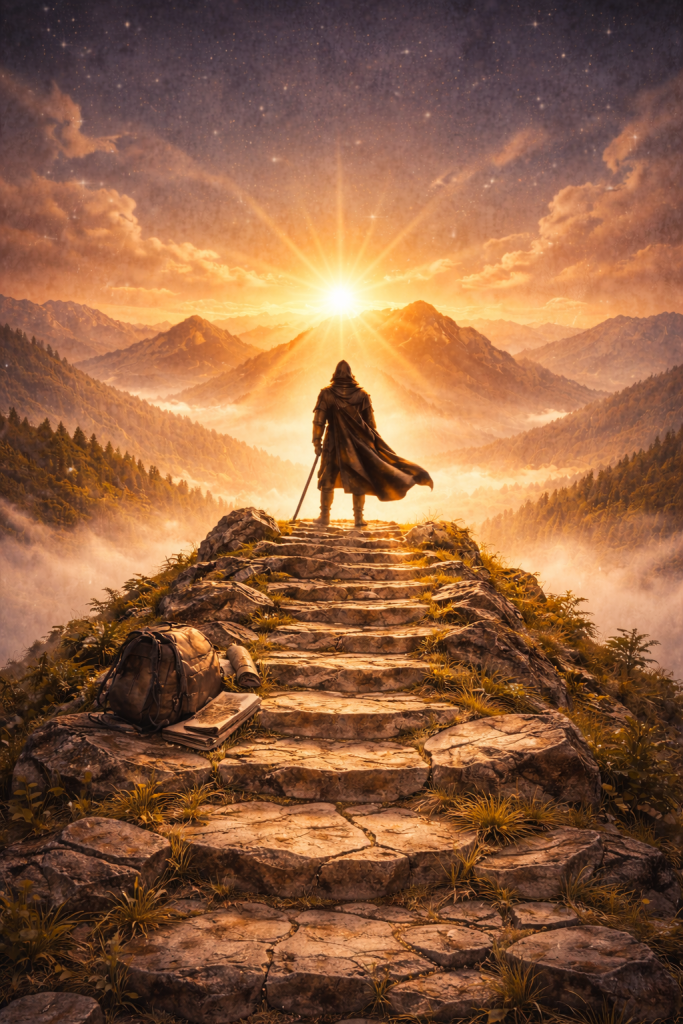
Kael planted his boot on the final stone and stood at the summit, his cloak snapping in the wind that had carried the screams of a thousand battles, sword at his hip, pack at his feet. Below him, the world fell away in waves of mist and mountain, forests he had burned, villages he had fought for, rivers that had run red and then clear again.
Before him: the Source.
It was not what he expected. No throne. No treasure. No voice booming from the heavens to tell him why. Only light—pure, golden, patient light—rising between the peaks like a breath held since the beginning of time.
He had killed his first man at seventeen. A raider, twice his size, who had come for his sister. The memory still lived in his hands, the way the sword had found its purpose, the way something in him had ignited and never quite gone out. They called it a gift. He called it a fire that needed feeding.
So he fed it. Campaign after campaign. He learned that victory was not the same as peace, that conquest was not the same as justice. He watched good men become monsters and monsters weep for forgiveness. He held dying friends who asked him why, and he had no answer except to keep climbing.
Now, standing in that light, he understood. The summit was not the end. It was the place where what you carried falls away.
In the stillness beneath the wind, something in him recognized something outside of words.
He sat down on the stone and stayed there for a long time, not praying—he had never learned how—but listening. And in the listening, the silence of the peaks and the silence beneath the villages were the same silence—as was the wind howling through the mountain passages and the distant hum of life in the village.
He stood, light.
He had been looking at it—the point of light between the peaks. That was what minds do. To look at something is to stand apart from it, to draw a line between seer and seen. His mind had made the Source into a destination, a thing to reach, because that was all his mind knew how to do. It could not accept is without is not.
He turned toward the village below.
He was not positioning himself to receive.
He was releasing the need to see.
And in that release, there was no Source apart from him, no warrior apart from it. There was no light entering him, no warmth traveling through his spine. These things did not happen because there was no distance for them to cross, no sequence for them to follow. The separation had only ever been a story his mind told, and the story simply stopped.
All at once. Everything. Already whole. Already home.
But he was human, and he lived in time. A mind cannot hold totality—it shatters against it, or it translates. So his experience unfolded the only way a human experience can: as a story, with a beginning and middle and end.
He felt what he had known as the distant Source first in his heart—not the organ, but the center. The place where he had always known things before he could explain them. The place that had recognized enemies and allies in a single glance, that had told him when to strike and when to hold, that had broken and mended and broken again across twenty years of war. It softened now. Opened. In a way he had not allowed since boyhood, since before he learned that openness was weakness and weakness was death.
Then it rose—not through a channel, not along a path, but through everything at once, up through his entire being to his brain and inward to his mind. What had always warred in him fell silent. Not because one side won, but because there had only ever been one side, wearing masks.
His body followed. Shoulders easing. Spine straightening. Hands open.
None of this took time. All of this took time.
What he had believed himself to be could not continue—not because it was destroyed, but because it had never existed except as a story. His mind no longer acted separately from his spirit, and his spirit was no longer walled off by his mind from what had always been there. Nothing was transformed. What had always been true was no longer obscured.
He appeared to breathe as before. But each breath was no longer his alone. It rose and fell with the eternal rhythm—reality into illusion, illusion into reality, over and over, the way a wave rises from the ocean and returns without ever having left.
The climb had been long, its destination unknown. The way toward the village was clear. There were others who might make the same journey.
No songs. No chronicles. Only a helping hand when needed.
He took the first step toward the village.