When you’re starting your fitness journey, understanding how your body moves through space can transform your training results. The human body operates through three distinct planes of motion, yet most beginners unknowingly limit themselves to forward and backward movements. This comprehensive guide introduces planes of motion exercises for beginners that will help you develop balanced strength, prevent injuries, and build a foundation for long-term fitness success.
Learning planes of motion exercises for beginners isn’t just about variety—it’s about training your body the way it naturally functions in daily life. Whether you’re reaching overhead for a shelf, stepping sideways to avoid an obstacle, or twisting to look behind you, your body constantly moves through multiple dimensions.
What Are the Three Planes of Motion?
Before diving into specific planes of motion exercises for beginners, you need to understand the basic framework of human movement. Your body moves through three imaginary planes that intersect at your center of gravity, dividing your body into distinct sections.
Understanding the Sagittal Plane Basics
The sagittal plane divides your body into left and right halves, running vertically from front to back. This is where most traditional exercises happen—movements like walking, running, squats, and bicep curls all occur in the sagittal plane. For those new to planes of motion exercises for beginners, this plane feels most natural because we primarily move forward and backward in daily life.
Sagittal plane movements include flexion (bending) and extension (straightening). When you bend forward to tie your shoes or reach down to pick something up, you’re moving through the sagittal plane. According to research from the National Strength and Conditioning Association, overemphasizing sagittal plane training while neglecting other planes creates muscular imbalances that increase injury risk.
Frontal Plane Introduction for New Exercisers
The frontal plane divides your body into front and back halves, running vertically from side to side. Movements in this plane include side-to-side actions like lateral lunges, side shuffles, and jumping jacks. Many planes of motion exercises for beginners neglect this crucial plane, which explains why so many people struggle with lateral stability and hip strength.
Frontal plane movements involve abduction (moving away from the body’s midline) and adduction (moving toward the midline). Think about stepping sideways off a curb or reaching across your body—these everyday movements require frontal plane strength that gym-goers often lack.
Transverse Plane Simplified for Beginners
The transverse plane divides your body into upper and lower halves, running horizontally through your waist. This plane involves rotational movements—twisting motions that are essential for athletic performance and injury prevention. When exploring planes of motion exercises for beginners, the transverse plane often receives the least attention despite its critical importance.
Rotation happens constantly in daily life: turning to look over your shoulder while driving, swinging a golf club, or reaching behind you for your seatbelt. The American College of Sports Medicine emphasizes that rotational strength is fundamental for core stability and spine health.
The 9 Essential Planes of Motion Exercises for Beginners
Now that you understand the framework, let’s explore specific planes of motion exercises for beginners that you can start practicing today. These nine movements provide comprehensive training across all three planes while remaining accessible for those new to structured exercise.
1. Squat Variations in the Sagittal Plane
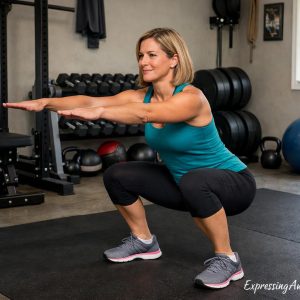
The bodyweight squat is the cornerstone of sagittal plane training and one of the most foundational planes of motion exercises for beginners. Stand with feet hip-width apart, toes pointing slightly outward. Lower your hips back and down as if sitting into a chair, keeping your chest lifted and weight in your heels.
Start with 3 sets of 10-12 repetitions. Focus on depth gradually—initially aim for thighs parallel to the floor, progressing deeper as mobility improves. This exercise builds lower body strength while teaching proper movement patterns that transfer to countless daily activities.
3- Side Plank with Hip Lift for Frontal Plane Strength
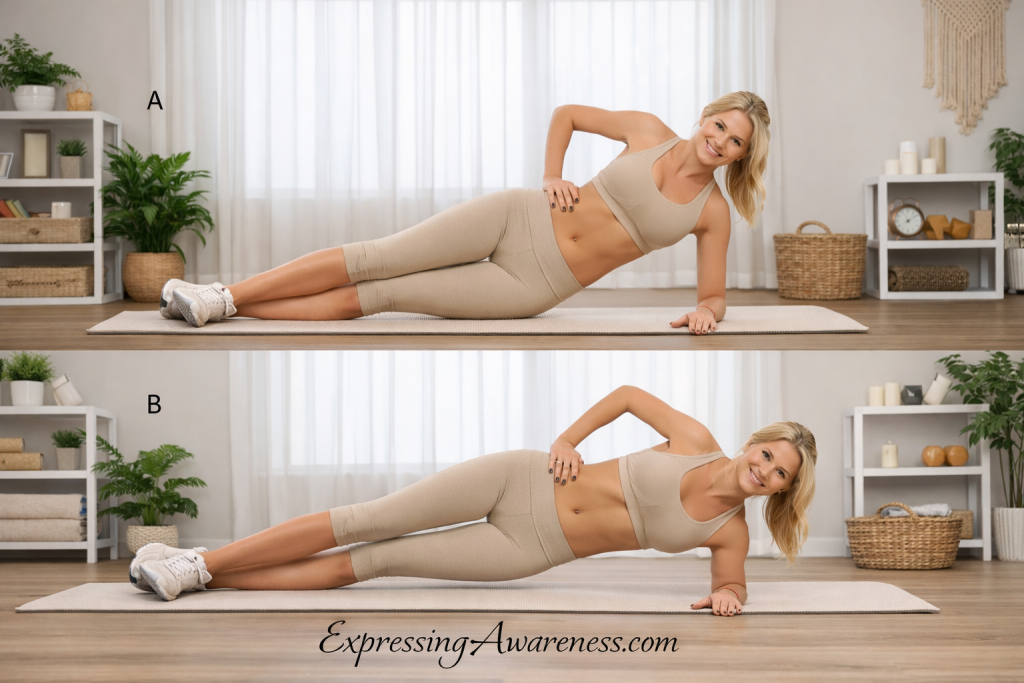
Side planks with hip lifts are an effective addition to your planes of motion exercises, emphasizing the frontal plane. Begin by lying on your side with your elbow directly under your shoulder and legs stacked or slightly staggered. Engage your core and lift your hips off the floor to form a straight line from head to heels. From this position, slowly lower your hips toward the floor, then lift them back up with control.
Perform 3 sets of 8–10 repetitions per side. This unilateral exercise targets the obliques, glutes, and hip stabilizers, helping improve lateral core strength and address side-to-side imbalances.
4. Side-to-Side Steps with Resistance
Another valuable addition to planes of motion exercises for beginners is the banded side-step. Place a resistance band around your thighs just above your knees. Stand with feet hip-width apart and knees slightly bent. Step sideways while maintaining tension in the band, then bring your other foot to follow.
Perform 3 sets of 15 steps in each direction. This exercise strengthens the hip abductors and improves lateral stability, which is crucial for preventing knee injuries and improving athletic performance.
5. Torso Rotation Exercises Made Simple
Moving to the transverse plane, standing torso rotations are fundamental planes of motion exercises for beginners building rotational strength. Stand with feet shoulder-width apart, holding a light medicine ball or household object at chest height. Rotate your upper body to the right while keeping your hips facing forward, then return to center and rotate left.
Start with 3 sets of 12 rotations per side. Keep movements controlled rather than using momentum—the goal is strengthening the obliques and developing anti-rotation stability in your core.
6. Wood Chops for Multi-Plane Integration
Wood chops beautifully demonstrate how planes of motion exercises for beginners can combine multiple planes simultaneously. Start with hands together overhead on your right side. Bring your hands diagonally down across your body toward your left hip, pivoting on your right foot as you rotate.
Execute 3 sets of 10-12 repetitions per side. This movement integrates sagittal, frontal, and transverse planes, teaching your body to coordinate complex, multi-dimensional movements that mirror real-life activities.
7. Combining Planes: The Walking Lunge with Rotation
This advanced variation ranks among the most comprehensive planes of motion exercises for beginners ready to progress. Perform a forward lunge, then at the bottom position, rotate your torso toward your front leg. Return to center, step forward into the next lunge, and rotate toward the new front leg.
Begin with 3 sets of 6-8 lunges per leg. This exercise challenges balance, coordination, and strength across multiple planes simultaneously, making it incredibly efficient for building functional fitness.
8. Lateral Reach and Return
Standing with feet hip-width apart, reach your right arm out to the side and slightly down while shifting your weight onto your left leg. Your body should create a slight arc leaning away from the reaching arm. Return to starting position and repeat on the opposite side.
This often-overlooked movement belongs in every collection of planes of motion exercises for beginners because it develops lateral flexion strength and improves shoulder mobility in the frontal plane. Perform 3 sets of 10 reaches per side.
9. Bird Dog with Rotation
The final exercise in our planes of motion exercises for beginners repertoire combines stability with controlled movement. Start on hands and knees, extend your right arm forward and left leg back. Bring your elbow and knee together under your body with a twisting motion, then extend again.
Complete 3 sets of 8-10 repetitions per side. This exercise develops anti-rotation core strength while teaching your body to maintain stability during dynamic movement—a skill that protects your spine during daily activities.
Building Your First Multiplanar Routine
Now that you know the individual exercises, let’s discuss how to structure planes of motion exercises for beginners into an effective workout routine. The key is balanced representation across all three planes while respecting your current fitness level.
A beginner-friendly routine might include two exercises from each plane, performed 2-3 times per week. For example: bodyweight squats and forward lunges (sagittal), lateral lunges and side-steps (frontal), and torso rotations and wood chops (transverse). This ensures comprehensive development without overwhelming your recovery capacity.
Start each session with a 5-10 minute dynamic warm-up that includes movements from all three planes. Gentle arm circles, leg swings (forward/back and side-to-side), and torso twists prepare your body for multi-directional training. When learning planes of motion exercises for beginners, proper warm-up reduces injury risk and improves movement quality.
Progression Strategies for Each Plane
As you become comfortable with basic planes of motion exercises for beginners, strategic progression ensures continued improvement. In the sagittal plane, progress from bodyweight movements to holding light dumbbells, then gradually increase resistance. For squats, this might mean holding a goblet squat position, progressing to back squats as technique solidifies.
Frontal plane progression often involves adding resistance bands or holding weights during lateral movements. You might start with bodyweight lateral lunges, advance to holding a kettlebell at chest height, then progress to single-leg variations that challenge balance and stability simultaneously.
For transverse plane movements, increase the speed of rotation (while maintaining control) or add resistance through bands or cables. The planes of motion exercises for beginners outlined here can sustain your progression for months by manipulating these variables: resistance, speed, range of motion, and stability challenges.
Common Mistakes to Avoid
Even with proper instruction on planes of motion exercises for beginners, several common errors can compromise your results or increase injury risk. Understanding these pitfalls helps you train more effectively from the start.
Neglecting the Frontal and Transverse Planes: The most frequent mistake is sticking exclusively to sagittal plane movements because they feel familiar. Challenge yourself to include lateral and rotational exercises in every workout, even when they feel awkward initially.
Moving Too Fast: When learning planes of motion exercises for beginners, speed often compensates for lack of strength or stability. Slow, controlled movements build better neuromuscular patterns and reduce injury risk. If you can’t perform an exercise slowly with good form, you’re not ready to speed up.
Ignoring Hip and Shoulder Mobility: Limited mobility restricts your ability to move effectively through all planes. Incorporate mobility work before attempting complex multi-planar exercises. Poor mobility in lateral movements or rotations signals the need for dedicated flexibility training.
Forgetting About Foot Position: Your feet establish the foundation for all movement. During sagittal plane exercises, feet should point forward. In frontal plane movements, ensure your stepping foot stays parallel rather than turning inward or outward, which can strain the knee.
Overcomplicating Too Soon: While planes of motion exercises for beginners can eventually become quite sophisticated, starting with complex variations before mastering basics invites frustration and injury. Build confidence with fundamental movements before attempting combined-plane exercises.
Expert Tips and Advice for Success
Maximizing your results with planes of motion exercises for beginners requires more than just knowing the movements—it demands smart training strategies and consistent application.
Film yourself performing exercises: Video feedback reveals form issues that you can’t feel in the moment. Record your lateral lunges or rotational movements from multiple angles to ensure proper alignment and movement quality.
Train balance progressively: Many planes of motion exercises for beginners challenge balance, especially single-leg and rotational movements. Don’t be discouraged if you wobble initially—balance improves rapidly with practice. Consider holding a wall or chair for support until stability develops.
Respect your body’s asymmetries: Most people have a stronger or more coordinated side. This becomes obvious when practicing planes of motion exercises for beginners, particularly unilateral movements. Rather than matching your weaker side to your stronger side immediately, give your less-developed side extra attention and practice.
Integrate daily life awareness: Between formal workouts, notice how you move through different planes during daily activities. When you reach across your body for something, recognize that as a transverse plane movement. This mindfulness reinforces learning and helps you appreciate the relevance of your training.
Prioritize consistency over intensity: When beginning with planes of motion exercises for beginners, showing up regularly with moderate effort produces better long-term results than sporadic intense sessions. Aim for 2-3 weekly sessions rather than one exhausting workout that leaves you too sore to train again for days.
Listen to your body’s signals: Muscle fatigue during and after exercise is normal and expected. Sharp pain, especially in joints, indicates a problem. If certain planes of motion exercises for beginners cause joint discomfort, reduce range of motion, decrease resistance, or consult a fitness professional about modifications.
Celebrate small victories: Notice when lateral lunges feel less awkward or when you can rotate further without losing balance. These improvements indicate your nervous system is adapting to multi-planar movement patterns—exactly the goal of training planes of motion exercises for beginners.
Conclusion: Your Journey Toward Balanced Movement
Mastering planes of motion exercises for beginners represents far more than learning new workout moves—it’s about developing comprehensive physical literacy that serves you in every aspect of life. By training your body to move confidently through sagittal, frontal, and transverse planes, you build resilience against injury while improving performance in sports, recreation, and daily activities.
The nine exercises outlined here provide a complete foundation for multi-planar training. Start with movements that feel most natural, gradually incorporating more challenging variations as your strength and coordination improve. Remember that everyone begins somewhere, and the awkwardness you might feel during initial attempts at planes of motion exercises for beginners is completely normal and temporary.
Commit to practicing these movements 2-3 times per week for the next month. You’ll be amazed at how quickly your body adapts to moving in new directions. Your balance will improve, your core will strengthen, and you’ll move through daily life with greater ease and confidence. The investment you make now in learning proper planes of motion exercises for beginners will pay dividends throughout your entire fitness journey and beyond.