She didn’t come to talk about functional movement. She came to talk about pain.
It lived in her shoulders first, then crept into her neck, her hips, her lower back. Some days it moved around, some days it stacked itself in one place like it had decided to stay. She told me she exercised regularly and did “a little bit of everything.”
I asked her what “everything” meant.
She described her routine: classes, machines, repetitions, variety. Different exercises every week. New angles, new equipment, new names for movements that promised balance and strength. It sounded full—almost crowded.
I didn’t explain anything yet. Instead, I handed her a rope.
“Just coil it on the ground,” I said.
She did what almost everyone does. She moved in one direction, laying loop after loop on top of itself. The coil looked neat. Efficient. Familiar.
“Now pin one end with your foot,” I said, “and pull the other.”
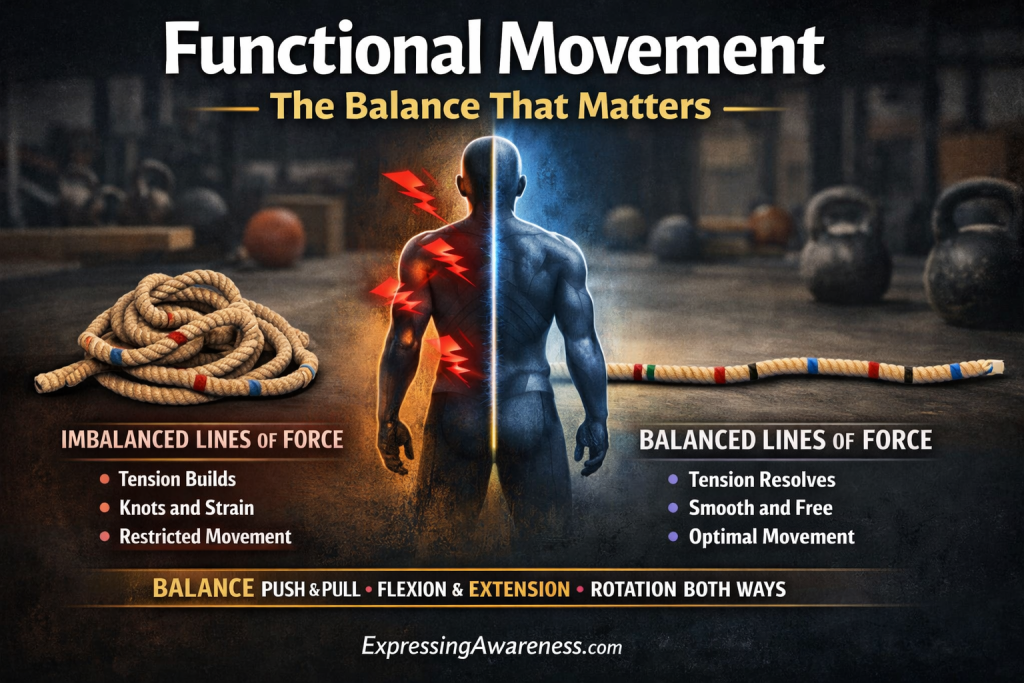
She pulled. The rope twisted, tightened, fought itself. It knotted halfway down and refused to straighten.
She laughed. “That’s annoying.”
“That,” I said, “is your shoulder.”
I took the rope from her hands.
“This time, watch the loops.”
I made one loop clockwise, the next counterclockwise. One over, one under. Each loop was the opposite of the one before it. When I set the rope down and pulled, it slid out smoothly—no kinks, no resistance, no tension trapped inside.
Her expression changed. Less laughter. More recognition.
“That’s different,” she said.
“Yes. Because each loop canceled the other.”
What Balance Really Means
Then I picked up a Sharpie and made marks on the rope about every four inches.
“Each mark represents a muscle,” I said. “The force that travels through your body when you move passes through these muscles as it passes through this rope.”
She looked at the marks.
“When people talk about muscle balance, they often mean balancing one segment against another—quad against hamstring, bicep against tricep.” I pointed to two adjacent marks. “Balancing the segments is not the same as balancing the rope.”
I coiled the rope again in one direction, all the marks visible along its length.
“Every segment here could be perfectly balanced with its neighbor. Strong quads, strong hamstrings. But watch.”
I pinned one end and pulled. The rope knotted.
“The segments were balanced. The line of force was not.”
She stared at the knot.
“Think about reaching into your car to grab groceries,” I said. “You’re twisting, reaching, lifting—all at once. Force travels from your hand through your arm, shoulder, core, hip, leg, into the ground. One continuous line. If your back goes out, it probably has little to do with whether your quads and hamstrings were balanced. The knot is somewhere else along the line—a rotation never trained in both directions, a transition that couldn’t handle load.”
I coiled the rope again, alternating loops, with marks still visible.
“Functional movement trains the lines of force, not just the segments. It asks: Does this rope run straight when pulled? Does force flow through without knotting?”
I pulled. The rope straightened. Every mark is aligned.
“This is what balance means in functional movement. Not segment against segment. Rope against rope. Line of force against line of force. Push balanced with pull. Flexion balanced with extension. Rotation in one direction balanced with rotation in the other.”
She was quiet, holding the rope.
“So all my variety…” she started.
“…was coiling the same direction,” I said. “The segments may have been strong. But the lines of force were stacking tension, not canceling it.”
What Is Functional Movement?
Functional movement refers to exercises that train the body to move the way it was designed to move. It integrates multiple joints, muscles, and planes of motion into coordinated patterns.
Functional movement also prepares the body for the specific demands of daily life and profession. A writer needs functional movement to sit, reach, and type comfortably. A carpenter needs it to lift, carry, and swing. A parent needs it to bend, hold, and chase. Whatever the task, functional movement helps the body meet it with ease.
Variety is a valuable part of any fitness program. Different machines, different classes, different exercises—all contribute to a well-rounded routine. One element that helps make things work even better is when the movements themselves balance the lines of force that pass through the body.
Redundancy and Omissions
Recognizing redundancy and omissions in a fitness program speeds up progress and helps prevent injury.
Consider squats, lunges, and treadmill work. These three exercises look and feel different, but they share similar mechanical demands: all three load the quadriceps and repeatedly engage the hip flexors. This is redundancy: apparent variety that repeats the same muscular patterns.
Meanwhile, full hip extension work—movements that strengthen the glutes and hamstrings while lengthening the hip flexors—often receives less attention. This is an omission.
Spotting these patterns opens the door to better balance and faster results.
The Core Principle: Balanced Lines of Force
Functional movement chooses exercises that balance the lines of force passing through the body.
This means:
- Push lines balanced with pull lines
- Flexion lines balanced with extension lines
- Rotational lines balanced in both directions
- Each rope running straight, each line resolving
When force travels through a balanced system, joints maintain space. Muscles work in coordination. The body moves freely.
When lines of force are unbalanced—loops stacked in one direction—tension accumulates somewhere along the chain. Under load, the rope knots. The back goes out. The shoulder aches.
Applying Balanced Lines of Force
Adding functional movement to a program means pairing what you already do with its complement—not to balance muscles against muscles, but to balance lines of force.
For every press, add a pull. Bench presses and push-ups create lines of force moving away from the body. Rows and pull-ups create lines moving toward. Pairing them balances the ropes.
For every crunch, add an extension. Spinal flexion creates lines of force that curl the body forward. Extension creates lines that open the back. Pairing them keeps the spine’s ropes running straight.
For every forward pattern, add a backward one. Walking lunges and hip hinges load the body in different directions along the same chains. Pairing forward and backward patterns balances the lines.
For every rotation, mirror it. Twisting in one direction creates rotational force through the core and spine. Mirroring it cancels the spiral tension before it accumulates.
The goal is resolution—lines of force that balance each other, leaving the body neutral, capable, and free.
Functional Movement in Daily Life
When lines of force are balanced, daily tasks change. Reaching into the car for groceries, force flows from ground to hand without knotting. Picking up a child, the chain holds. Twisting to look behind, the spine rotates freely and returns.
This is what functional movement offers: a body where every line of force has its opposite, every loop cancels, every rope runs straight.
The writer sits and types without stiffness—the lines from fingertip to shoulder to spine are balanced. The carpenter lifts and swings without strain—push and pull, rotation left and right, all accounted for. The parent bends and chases without hesitation—the ropes carry the load together.
Conclusion
She came back weeks later. The pain hadn’t disappeared overnight, but it had stopped spreading. Her movements felt smoother. Lighter. Like something inside had finally been untangled.
“That rope thing,” she said, smiling. “I think about it every time I train.”
“That’s the point,” I said. “Functional movement isn’t just about how much force you can produce. It’s about whether your lines of force balance—or whether they knot.”
Functional movement is the practice of balancing lines of force through the body. It recognizes that muscle balance—segment against segment—is only part of the picture. The deeper question is whether the ropes themselves are balanced. Whether push cancels pull, flexion cancels extension, or rotation cancels rotation.
When they do, tension resolves instead of accumulating. The body moves the way it was designed to—straight, capable, and free.
Functional fitness and movement in daily life — Mayo Clinic
https://diet.mayoclinic.org/us/blog/2021/functional-fitness-is-it-right-for-you/ — Functional fitness exercises train muscles to work together and prepare the body for everyday movements, improving efficiency and reducing injury risk